Israel Election: 6-Seat Gap Leaves Both Blocs Short of Majority
Final polls show the opposition leading by six seats, yet neither side can reach the 61 required to govern without Arab parties, which most leaders refuse to court.
By Julian Vargas ·
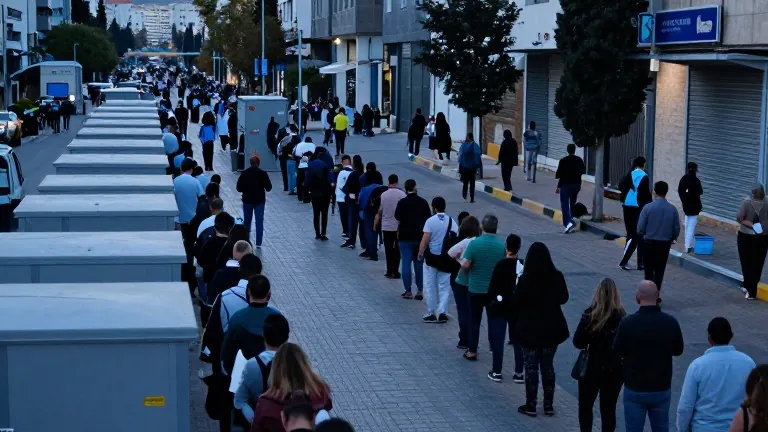
Polls opened across Israel on Tuesday morning, October 27, in a race that has left both major political camps mathematically stranded. The central tension in the election is not who will lead, but how either side will form a governing coalition. Current projections show a six-seat gap between the two blocs, a margin that leaves neither with the 61 seats needed for a majority in the 120-seat Knesset.
The opposition bloc, led by Gadi Eisenkot’s Yashar party, is projected to win 56 seats according to the final Channel 12 poll released Friday. Prime Minister Benjamin Netanyahu’s camp is projected to capture 50 seats. This leaves the Arab parties, who are projected to win a combined 16 seats, as the potential swing vote. Most opposition leaders have pledged to govern without them, citing the political difficulty of forming a coalition after the October 7, 2023, Hamas attack.
Eisenkot’s Yashar party is projected to win 22 seats, making it the largest party in the incoming Knesset. This leads Likud, which is projected to fall to 19 seats from its current 32. Former prime minister Naftali Bennett’s B’Yachad party is projected to win 14 seats. The shift in party strength reflects a realignment in the market of political support since the last election in 2022.
The election outcome hinges on voter turnout, which directly affects the threshold for entry. The legal threshold is set at 3.25% of valid votes. According to calculations by the Taub Center, a party needs 165,635 votes to cross this line if turnout matches the 70% rate seen in 2022. As turnout increases, the required vote count rises, creating a higher barrier for smaller parties. This dynamic puts pressure on niche parties to maximize their vote share.
Two parties are fighting to clear this threshold: Ofer Winter’s People of Israel party and Yoaz Hendel’s Reservists-Economics party. Their success will determine the final seat count for both blocs. If they cross the line, they may hold the balance of power in coalition talks. If they fail, their supporters will be left without representation, potentially shifting the internal dynamics of the larger parties.
Voters are weighing specific economic and security factors in their decision. The Israeli Defense Forces faces a manpower crisis after three years of war, a cost that impacts national planning. The contentious haredi conscription legislation remains a point of friction between secular and religious voters. Additionally, many voters are focused on the establishment of a state commission of inquiry into the failures surrounding the October 7 attack.
Traditional issues, such as the establishment of a Palestinian state, have moved to the background. Most parties now stand in agreement against Palestinian statehood, a shift that has narrowed the ideological gap between the blocs. The fate of Benjamin Netanyahu, who has led Israel for 19 non-consecutive years, is a central question. The opposition has called for him to be held accountable for the events of October 7, arguing he should no longer serve.
Voting at diplomatic missions abroad concluded on October 16, while military bases began voting last week. Polls opened at 7:00 a.m. local time, and exit polls are expected at 10:00 p.m. to provide preliminary projections. Official results will be finalized in the coming days after the full count is completed. The final numbers will determine the size of the Knesset and the starting position for coalition negotiations.
Police have deployed approximately 20,000 officers and volunteers nationwide to maintain order. Forces are stationed at thousands of polling stations and in surrounding areas. The police aim to safeguard the integrity of the elections and ensure the democratic process is conducted in accordance with the law. This security presence is a standard measure for high-stakes elections in the country.
Source: The Jerusalem Post
More Business · Business Watchdog · Report a business · Got a Story?